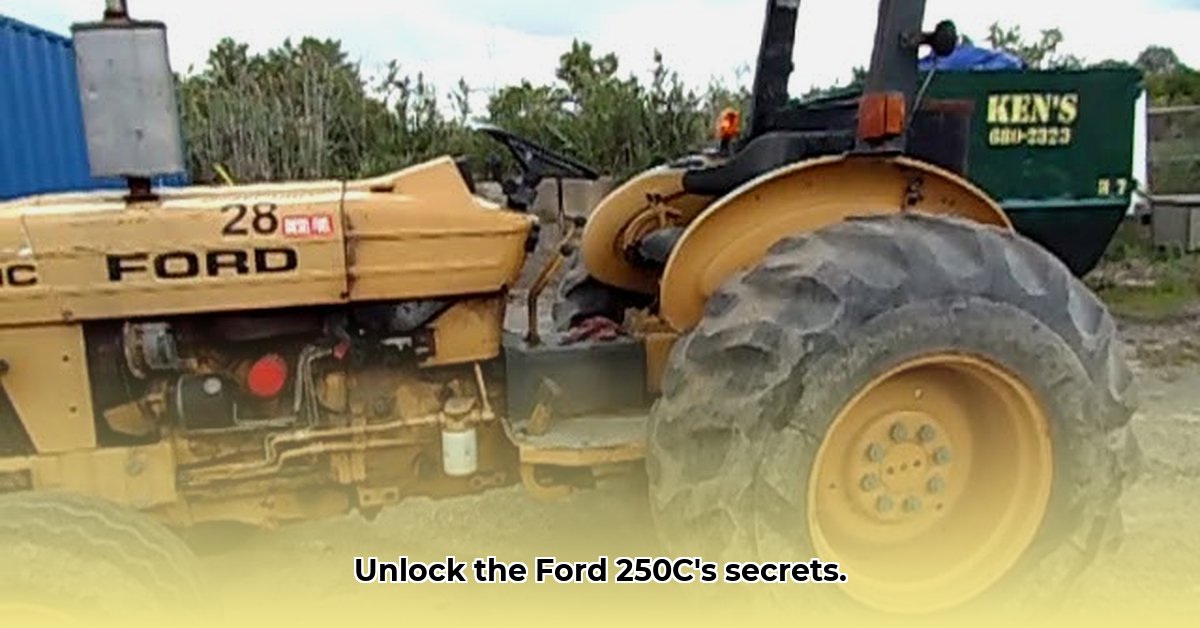
The Ford 250C tractor, a product of the late 1980s, represents a significant chapter in agricultural machinery history. While largely obsolete in modern farming, its design and capabilities offer valuable insight into the evolution of agricultural technology. This guide provides a comprehensive overview of the Ford 250C, examining its specifications, historical context, and remaining market relevance. For more in-depth details, check out this detailed guide.
Technical Specifications: A Detailed Look
The Ford 250C boasted a robust 3.1-liter, three-cylinder diesel engine, producing 56 gross horsepower—a respectable output for its era. Power delivery relied on an eight-speed transmission, available in either constant mesh or torque converter configurations. A 44-horsepower power take-off (PTO) (a mechanism for powering farm implements) facilitated various agricultural tasks. The hydraulic system, operating at 2200 psi, enabled a rear lift capacity of 3080 lbs. Farmers could choose between two-wheel drive (2WD) and four-wheel drive (4WD) variants, adapting to diverse terrain and workload demands. Standard features included power steering and wet disc brakes.
| Specification | Detail | Notes |
|---|---|---|
| Engine | 3.1L 3-cylinder Diesel | Reliable, though parts sourcing may be challenging. |
| Horsepower (Gross) | 56 hp | Sufficient for many tasks in the late 1980s. |
| Transmission | 8-speed (Constant Mesh or Torque Converter) | Choice offered operational flexibility. |
| PTO Horsepower | 44 hp | Ample power for common implements of the time. |
| Hydraulic System Pressure | 2200 psi | Strong lifting capacity for its era. |
| Rear Lift Capacity | 3080 lbs | Supported a range of agricultural implements. |
| Drive Options | 2WD & 4WD | Versatility for varying field conditions. |
Historical Context and Design Analysis: A Technological Snapshot
The Ford 250C’s design reflects the engineering priorities of its time. While its horsepower pales in comparison to modern tractors, its features—such as the mechanical differential lock and transmission options—prioritized dependable operation and robust build quality. Its open-center hydraulic system, typical of the late 1980s, contrasts with the closed-center systems common in contemporary tractors. This simpler design, however, potentially contributed to the tractor's overall longevity and reliability.
Market Assessment: A Collector's Item?
The Ford 250C is rarely seen in active agricultural use today. Its scarcity, however, makes it attractive to collectors and restoration enthusiasts. Its historical significance and limited availability may contribute to its value appreciation over time. For modern farming operations, though, the Ford 250C is generally considered obsolete. Isn't it fascinating how a machine's obsolescence can actually increase its value?
Actionable Intelligence for Key Stakeholders
The Ford 250C's market limitations impact various stakeholders differently:
Collectors: Online forums and specialized equipment dealers are crucial for locating parts and connecting with fellow enthusiasts. The primary focus is preservation and meticulous restoration.
Historians: The Ford 250C serves as a valuable case study for understanding technological advancements in agriculture. Comparing its features to modern tractors reveals substantial progress in power, efficiency, and technological integration.
Dealers: Unless specializing in antique farm machinery, dealers likely lack the market demand for the Ford 250C, focusing instead on current-generation tractors offering superior efficiency and capabilities.
Farmers: The Ford 250C's lower horsepower and less advanced features make it unsuitable for most contemporary farming operations, which demand greater productivity and technological integration.
Conclusion: A Legacy of Dependable Service
The Ford 250C, while no longer a mainstay in the farming industry, retains historical significance as a robust and reliable workhorse of its day. Its story highlights the remarkable progress in agricultural technology. For collectors and enthusiasts, the Ford 250C presents an intriguing restoration project and a testament to past agricultural engineering. However, understanding its limitations within the modern agricultural context is crucial.